
Dentures
At Yonge & St. Clair.
Dentures can replace several or all missing teeth with a removable dental prosthesis. We assess your remaining teeth, supporting tissues, bite and priorities to determine whether a partial or complete denture or another approach makes sense.

Replacing missing teeth
Dentures can replace several or all missing teeth.
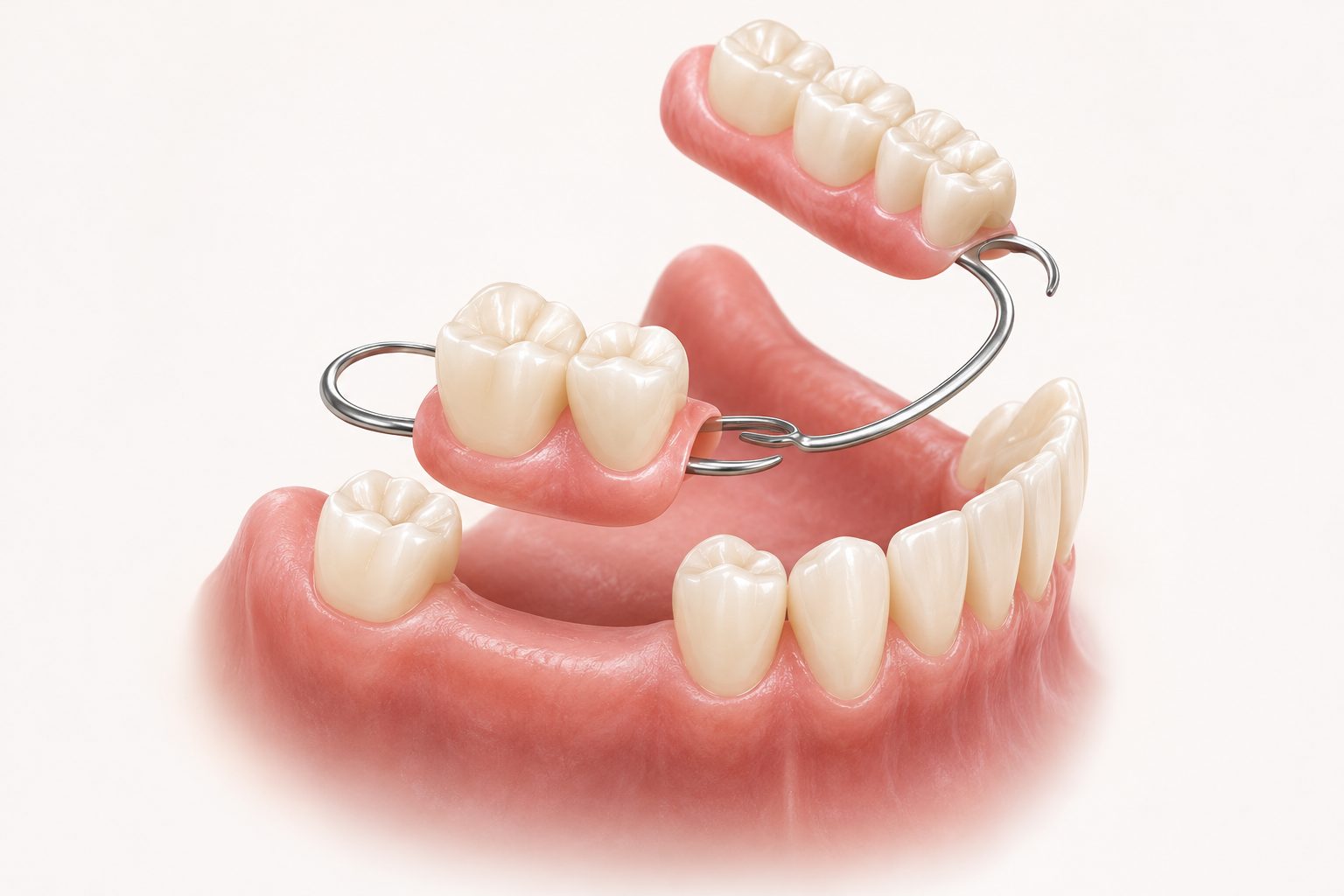
A denture is a removable dental prosthesis designed to replace missing teeth and surrounding structures.
A partial denture can replace multiple missing teeth when some natural teeth remain. A complete denture replaces the teeth in an arch when no natural teeth remain.
The right approach depends on what is missing, what remains and how the replacement needs to function.
The teeth that remain
What happens to my remaining teeth?
When some natural teeth remain, we first consider their health, prognosis and role in the overall restorative plan.
A tooth should not be removed simply to make treatment more convenient. At the same time, retaining a tooth that cannot reasonably contribute to a stable long-term result may not always be beneficial.
The question is not simply how many teeth remain. It's which teeth can reasonably remain.
The process
Making a denture takes planning.
Assess your mouth
We evaluate the missing teeth, remaining teeth, supporting tissues, bite and restorative needs.
Plan the type of denture
We determine whether a partial or complete denture is appropriate and how it should fit into the larger treatment plan.
Record the mouth and bite
Measurements and records are used to help design the denture and establish how the teeth should meet.
Evaluate the denture
Depending on the type of treatment, there may be steps to evaluate fit, tooth position, appearance and bite before completion.
Deliver and adjust
Once the denture is provided, adjustments may be needed as you begin using it.
Adjusting to dentures
Dentures can take time to get used to.
A new denture can feel unfamiliar at first. Speaking, eating and controlling a removable prosthesis may require an adjustment period.
The experience is different for every patient, and follow-up adjustments can be an important part of treatment.
A denture should be evaluated if it is persistently painful, unstable or interfering with normal function.
Replacement options
There may be more than one way to replace missing teeth.
Dentures are removable. Traditional bridges are fixed and use neighbouring teeth for support. Implant-supported restorations use implants placed in the jaw for support.
Dentures
Removable replacement for several or all missing teeth.
Dental bridges
Fixed replacement using neighbouring teeth for support.
Dental implants
Implant-supported replacement independent of neighbouring teeth in appropriate situations.
These aren't simply three versions of the same treatment. They solve the problem in different ways.
Ongoing care
Your mouth still needs regular dental care.
Denture care includes keeping the prosthesis clean and caring for the tissues and any natural teeth that remain.
Regular dental examinations also allow us to monitor changes in your mouth, your remaining teeth and how the denture is functioning.
Even when no natural teeth remain, changes in the mouth and oral tissues can still require professional assessment.
Common questions
Common questions about dentures.
What's the difference between partial and complete dentures?+
Partial dentures replace selected missing teeth when natural teeth remain. Complete dentures replace all teeth in an upper or lower arch.
Are dentures removable?+
Yes. Conventional partial and complete dentures are removable prostheses.
How long does it take to get used to dentures?+
Adjustment varies. Eating, speaking and controlling a new denture can feel different initially, and follow-up adjustments may be needed.
Should I get dentures or dental implants?+
Neither is automatically appropriate for everyone. The decision depends on the missing teeth, remaining teeth and tissues, health factors, treatment requirements and your priorities.
Can implants help hold a denture in place?+
In some situations, implants can support or stabilize a dental prosthesis. A trusted periodontal specialist places the implants, and we plan your care and design and fit the denture they support.
Do loose dentures need to be replaced?+
Not necessarily. The denture and mouth should first be assessed to understand why the fit has changed and what treatment, if any, is appropriate.
How long do dentures last?+
There is no fixed lifespan for every denture. The prosthesis and the mouth can both change over time, so condition, fit and function are more useful than age alone.
Do I still need dental exams if I have complete dentures?+
Yes. Professional assessment remains useful for monitoring oral tissues, changes in the mouth and the condition and fit of the denture.
Related care
Considering dentures?
We'll assess what is missing, what remains and how your teeth need to function, then explain whether dentures or another replacement option makes sense.
Or feel free to email us at reception@smilemail.ca. We reply to appointment requests within one business day.